

Every year around this time, I start thinking about what I want the next year to look like.
And I do not wait until January 1st to do it.
As a mom of two, a dietitian, and a business owner, I know how easy it is to spend every day taking care of everyone else, reacting to what’s right in front of you, and putting your own goals on the back burner.
That’s exactly why I start planning for the new year in November.
Not because I want every minute of my life perfectly scheduled, but because I want to go into January with clarity. I want to know what I’m working toward, what matters most, and how I’m going to make time for those things.
In this guide, I’m walking you through my step-by-step goal-setting system, from choosing three meaningful yearly goals to breaking them into monthly priorities, weekly plans, and daily actions.
Because setting goals is one thing. Actually making time for them is another.

- Why New Year's Resolutions Don't Stick (And What to Do Instead)
- Step 1: Reflect before you set new goals
- Step 2: Choose just 3 big goals
- Step 3: Break each goal into actual steps
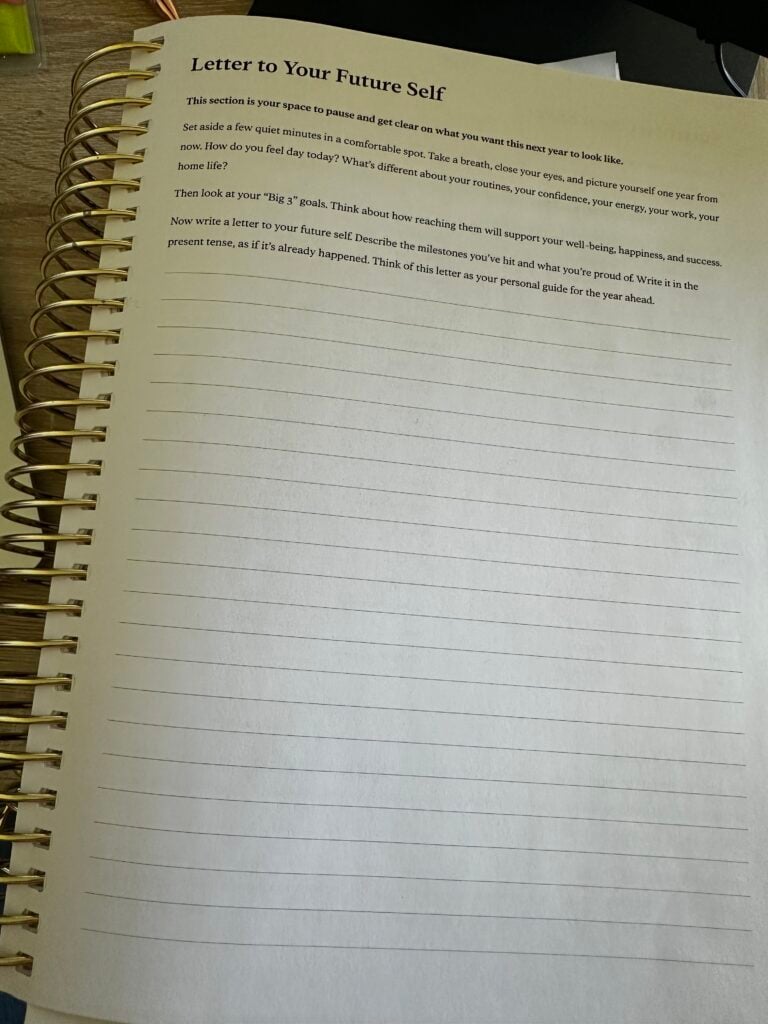
- Step 4: Visualize what success actually looks like
- Step 5: Turn yearly goals into monthly focus areas
- Step 6: Plan your week before the week starts
- Step 7: Plan your meals and health habits too
- Step 8: Plan your days the night before
- Step 9: Expect real life and adjust when needed
- Your 15-Minute New Year Goal-Setting Exercise
- The planning system I use
- Ready to turn your 2027 goals into an actual plan?
- Final thoughts
Why New Year’s Resolutions Don’t Stick (And What to Do Instead)
A lot of people do not struggle because they are lazy or unmotivated.
They struggle because their goals are too vague.
Things like:
- eat healthier
- get organized
- work out more
- be more productive
- take better care of myself
Those sound good, but they are hard to follow through on because they are not specific enough and they are not connected to an actual plan.
A goal without a plan is really just a wish.
The key is not setting more goals. The key is choosing a few meaningful goals and breaking them down into steps you can actually follow through on.
Step 1: Reflect before you set new goals
Before I write down what I want for the new year, I like to pause and reflect on the current one.
Ask yourself:
- What went well this year?
- What felt hard?
- What do I want more of next year?
- What do I want less of?
- Where did I make progress?
- Where did I feel stuck?
This matters because your goals should come from your real life, not just from what sounds good in the moment.
For example, if you spent the whole year feeling overwhelmed and reactive, maybe your goal is not to do more. Maybe your goal is to create better systems and routines.
If you felt like your health kept getting pushed aside, maybe one of your goals needs to be making time for movement, meal planning, or better nutrition.
Step 2: Choose just 3 big goals
This is one of the biggest things that has helped me.
Instead of making a giant list of resolutions, I choose 3 big goals for the year.
That is it.
These can be related to:
- health
- family
- business
- personal growth
- home life
- finances
- routines
The reason I like choosing 3 is because it forces you to be intentional. It helps you focus on what actually matters instead of filling a page with things that sound nice but are not realistic for this season of life.
Here are a few examples:
- Strength train consistently 3 times a week
- Get more organized with meal planning and family routines
- Grow a business in a way that still leaves room for family life
- Read 12 books this year
- Improve sleep and reduce evening scrolling
- Create more consistent family dinners at home
The point is not to choose impressive goals. The point is to choose meaningful ones.
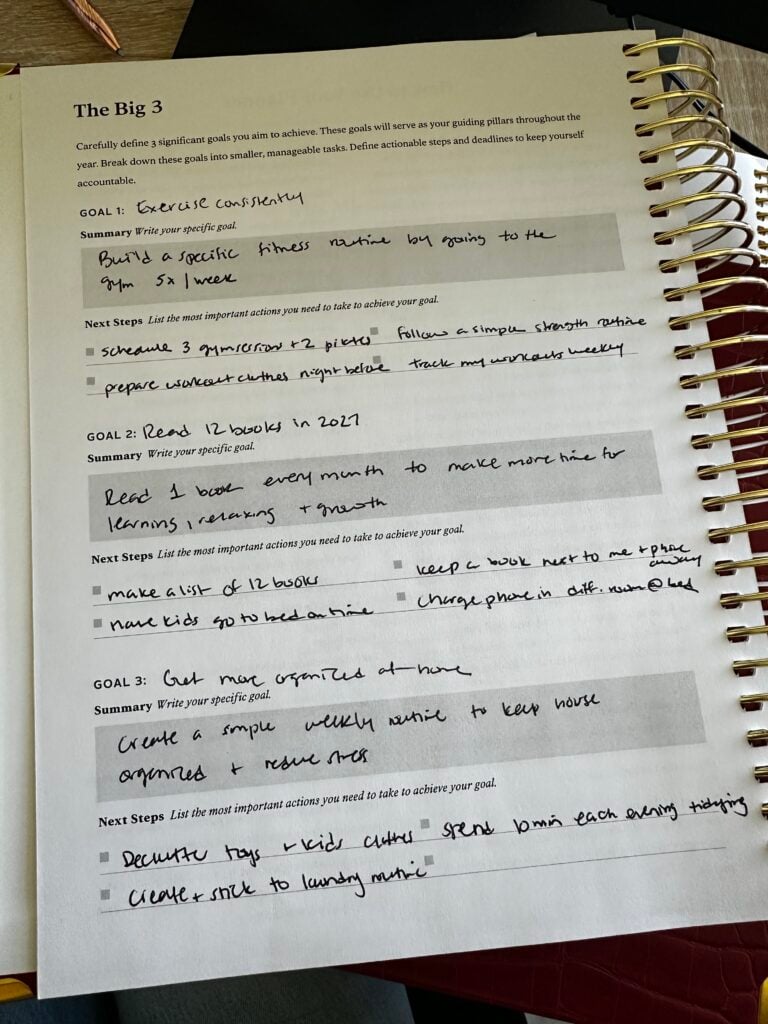
Here’s an example of how I filled out the Big 3 goals page in my 2027 Daily Planner. I chose three realistic goals related to fitness, reading, and home organization, then wrote down specific actions to help me accomplish each one.
I included this dedicated section in my planner because I wanted a place to do more than just write down New Year’s resolutions. I wanted to be able to revisit those goals throughout the year and turn them into actual plans.
Step 3: Break each goal into actual steps
This is where most people stop, but this is where the real work starts.
Once you have your 3 big goals, ask yourself:
What would need to happen for this goal to become real?
For example, if your goal is to feel healthier and stronger, the steps might be:
- schedule 3 workouts each week
- meal plan every Sunday
- increase protein at breakfast and lunch
- walk more consistently
If your goal is to be more organized, the steps might be:
- plan your week every Thursday or Sunday
- write down appointments and activities for the month
- choose your top 3 priorities each week
- spend 10 minutes every evening planning the next day
Your yearly goals should never live on an island by themselves. They need to connect to your month, your week, and your day.
Step 4: Visualize what success actually looks like
This may sound small, but it is one of my favorite parts of the process.
After setting my goals, I like to visualize what it would look like if I actually achieved them.
What would my life feel like?
What would my days look like?
How would I be spending my time?
What habits would I have?
This is helpful because it moves your goals from something abstract to something personal and real.
It also gives you something to come back to when motivation fades or life gets busy.
Because it will.
There will be weeks when you feel off track. There will be months that feel messy. That does not mean the goal no longer matters. It just means you need to reconnect to what you were working toward in the first place.
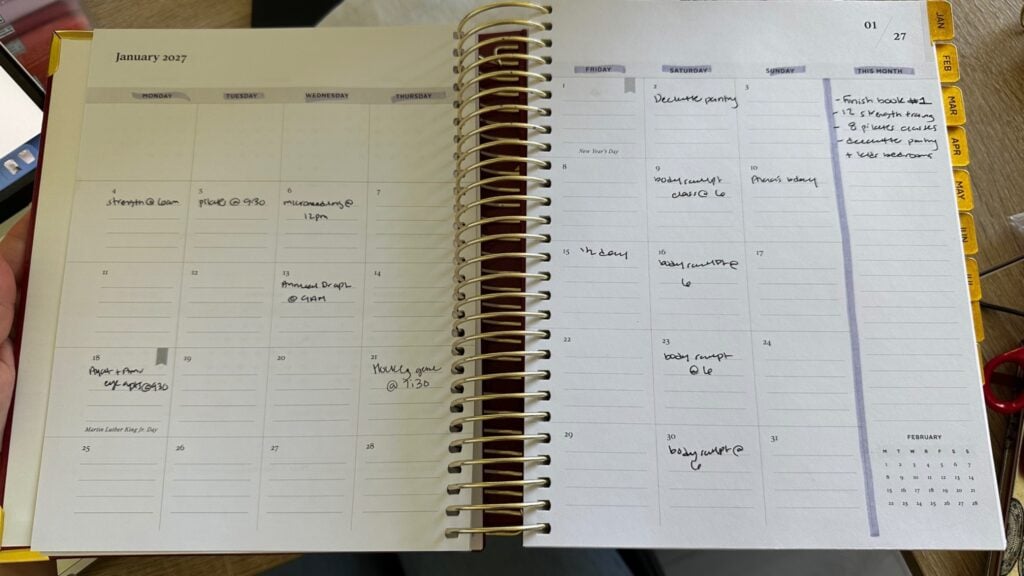
Step 5: Turn yearly goals into monthly focus areas
Once I know my big goals, I start thinking about what I can realistically focus on each month.
This is such an important step because it keeps you from trying to do everything all at once.
For example:
If one of your yearly goals is to improve your health, your January focus might be:
- planning breakfasts
- strength training 2 to 3 times a week
- increasing protein and fiber
If your yearly goal is better organization, your January focus might be:
- getting into the habit of weekly planning
- organizing your family calendar
- planning meals before each week starts
This is where goals start to feel manageable.
You do not need to transform your whole life in one week. You just need to know what you are focusing on right now.
Here’s what this looks like in real life
Example: Build a consistent fitness routine
| Yearly goal | Strength train 3 times per week. |
| January focus | Establish a consistent workout schedule. |
| Weekly plan | Schedule Monday, Wednesday, and Friday workouts. |
| Daily action | Pack my gym bag the evening before and block workout time. |
This is exactly how I use my planner. My yearly goals give me direction, but my monthly, weekly, and daily pages help me turn those goals into action.
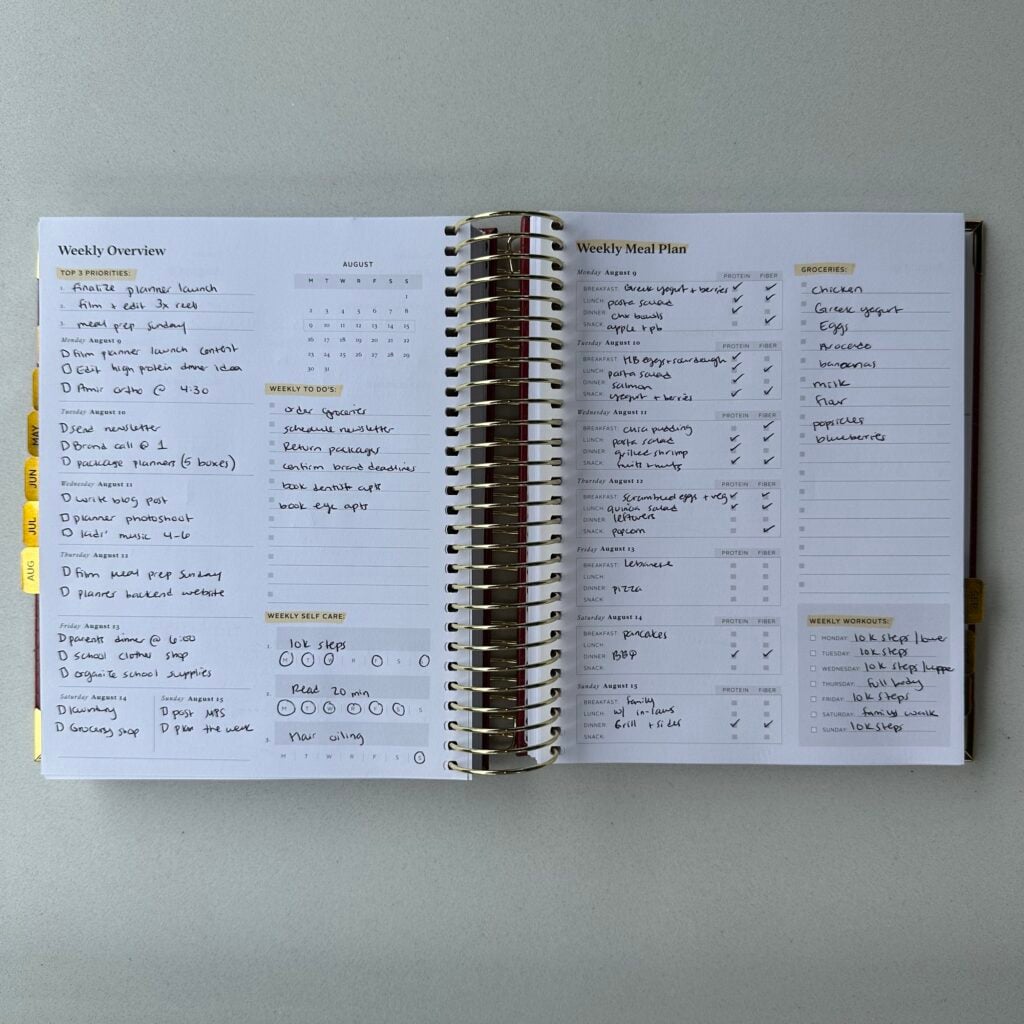
Step 6: Plan your week before the week starts
This is where your goals stop being ideas and start becoming part of your real life.
Every week, I sit down and map out what is coming up.
I think about:
- appointments
- kids’ activities
- work responsibilities
- meal planning
- workouts
- my top 3 priorities
- anything I need to do for myself
When I do this, I am much less likely to feel like the week is happening to me.
I already know what is coming, what matters most, and what needs to happen first.
A weekly planning routine is one of the best ways to reduce mental clutter, especially if you are constantly carrying your family’s schedule, meals, responsibilities, and your own goals in your head.
Step 7: Plan your meals and health habits too
As a dietitian, I really believe this is one of the most practical ways to support your goals.
If you want to eat better, feel better, or stop scrambling at 5 PM every day, you need a plan.
Meal planning does not have to be complicated, but it does need to be intentional.
Even just mapping out a few dinners, stocking staple groceries, and thinking ahead about breakfasts and lunches can make such a big difference.
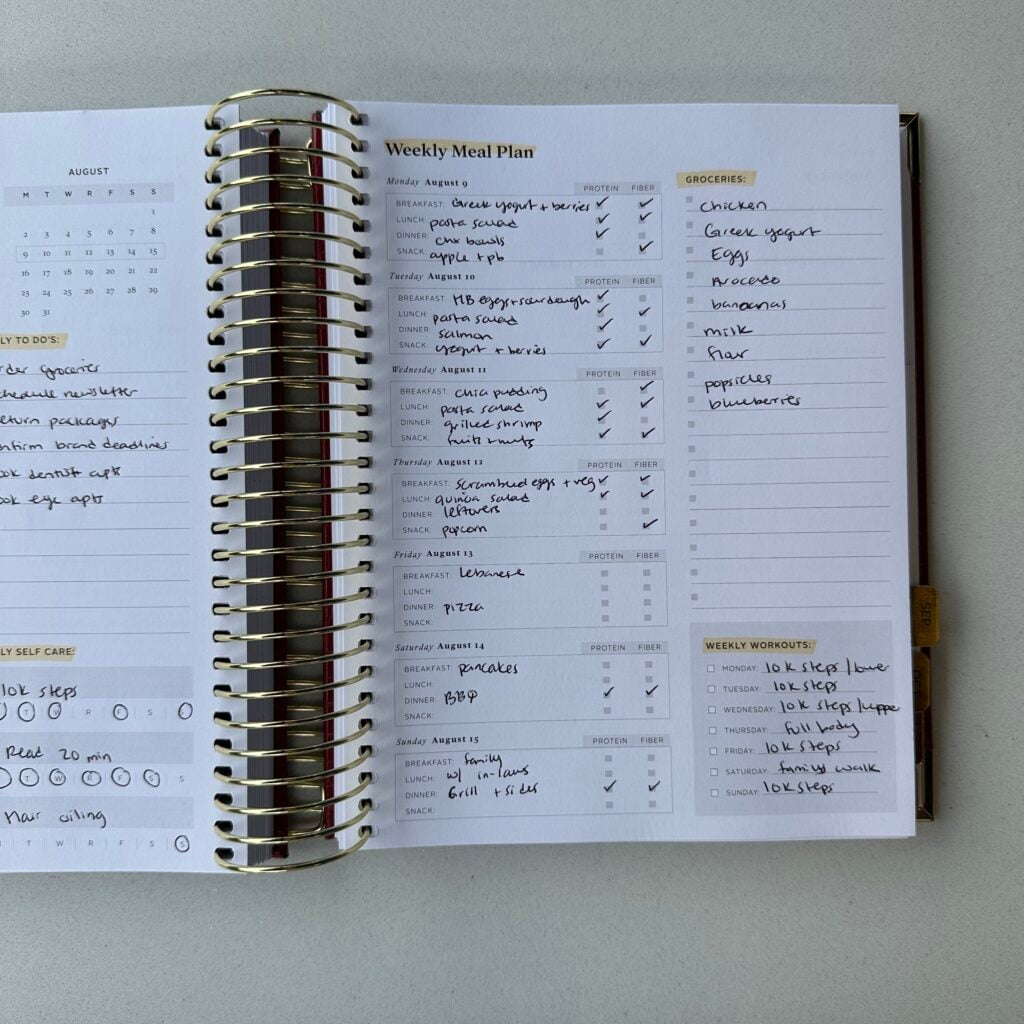
I also think it helps to visually keep track of your habits.
That is one reason I love having a protein and fiber checklist in my planner. It gives you a simple visual overview of how you are eating throughout the day and helps you see whether you are actually supporting your goals.
Writing things down can help you notice patterns, identify where you might need more balance, and make small adjustments without expecting every day to be perfect.
Step 8: Plan your days the night before
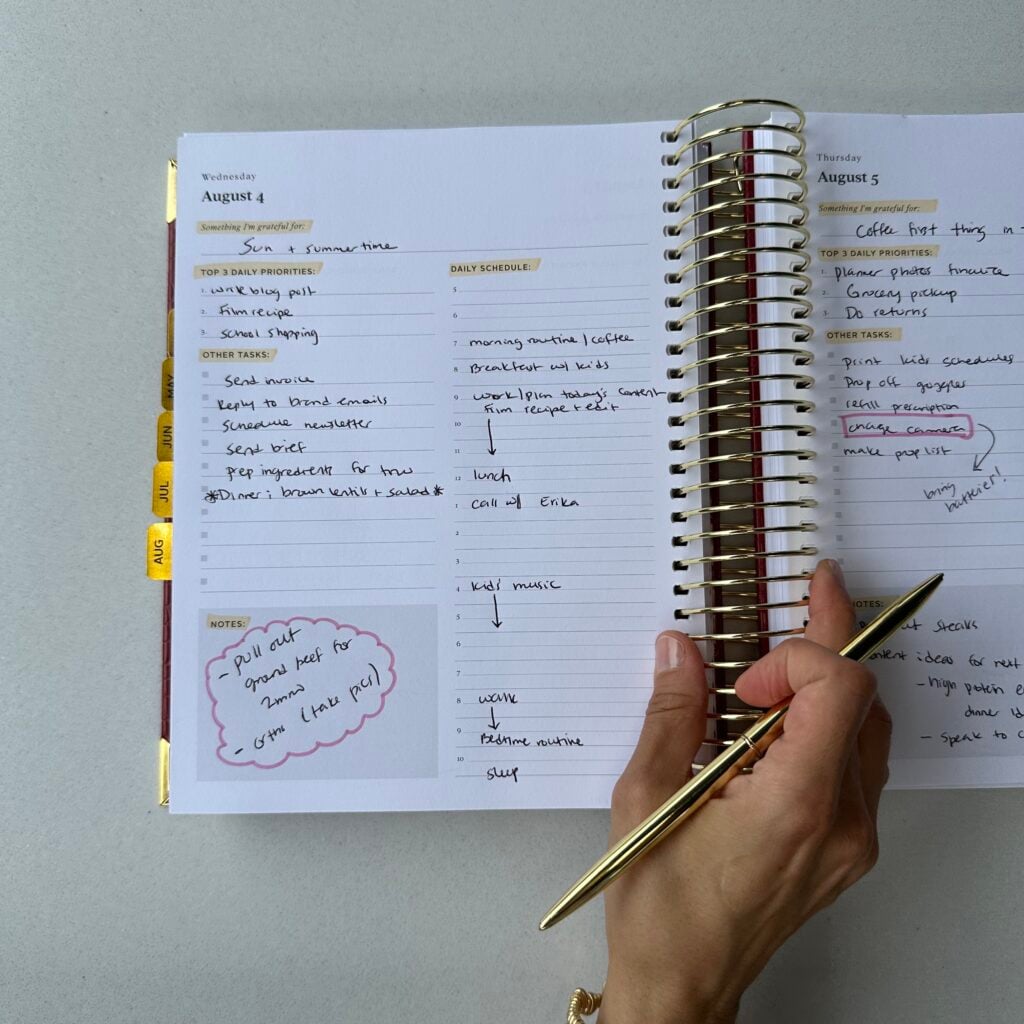
One of the most helpful habits I have built is planning the next day in the evening.
I do not do this because I want every second scheduled perfectly.
I do it because I want to wake up already knowing:
- what I have going on
- what my top priorities are
- what meals we are having
- where my workout or movement fits in
- what absolutely needs my attention
This helps me start the day feeling clear instead of immediately overwhelmed.
If you are in a season of life where a lot is being asked of you, this small habit can make a huge difference.
It helps you stop relying on memory and start relying on a system.
Step 9: Expect real life and adjust when needed
This is something I feel strongly about.
Goal setting should not make you feel like a failure the moment life gets hard.
There will be weeks where your plans change.
There will be sick kids, busy work weeks, travel, and seasons where survival mode is very real.
That does not mean your goals are over.
It just means you adjust.
The beauty of having a planning system is that it gives you something to come back to. You can reset, refocus, and keep going instead of feeling like one off week ruined everything.
Progress matters more than perfection.
Your 15-Minute New Year Goal-Setting Exercise
If you’re not sure where to start, here’s a simple exercise you can do today. Grab a notebook, your planner, and a pen, and set aside 15 minutes.
Minutes 1–3: Reflect on the past year.
Think about what went well, what felt challenging, and what you’d like to change.
Minutes 4–6: Choose your Big 3 goals.
Write down three meaningful things you want to accomplish in 2027. Think about your health, family, personal growth, or anything else that matters to you.
Minutes 7–11: Break your goals into action steps.
For each goal, write down four specific things you can do to make progress. Focus on actions that are realistic for your current season of life.
Minutes 12–15: Make a plan for January.
Look at your calendar and schedule at least one action that will help you move closer to each goal.
You don’t need to have the entire year figured out today. You just need a starting point.
And remember, the goal isn’t to fill every minute of your calendar. It’s to make sure you’re intentionally creating space for the things that matter to you.
The planning system I use
Over the years, I realized I did not need another random notebook or another disconnected to-do list.
I needed one place for:
- my yearly goals
- monthly plans
- weekly priorities
- daily schedule
- meal planning
- grocery lists
- protein and fiber tracking
- workouts
- self-care
- all the moving pieces of real life
Ready to turn your 2027 goals into an actual plan?
That’s exactly why I created my MomNutritionist Daily Planner.
From choosing your three big yearly goals to planning your months, weeks, meals, workouts, and daily priorities, everything is designed to help you stay organized and make time for what matters.
And as a busy mom, I know how valuable it is to have everything in one place.
The 2027 Weekly Planner is already sold out, and we’re down to the last batch of the Daily Planners. I only produce one batch each year, so once they’re gone, they won’t be restocked.
Final thoughts
You do not need to wait until January 1st to start thinking about the kind of year you want to have.
And you do not need a perfect plan.
You just need a little time to reflect, choose what matters, and start building a system that supports those things.
If you are a busy mom, I hope this reminds you that your goals matter too.
Not just your responsibilities.
Not just everyone else’s schedule.
Not just what needs to get done.
Your goals matter too.
And if you want a place to map them out and follow through on them, that is exactly what my planner is designed to help you do.