
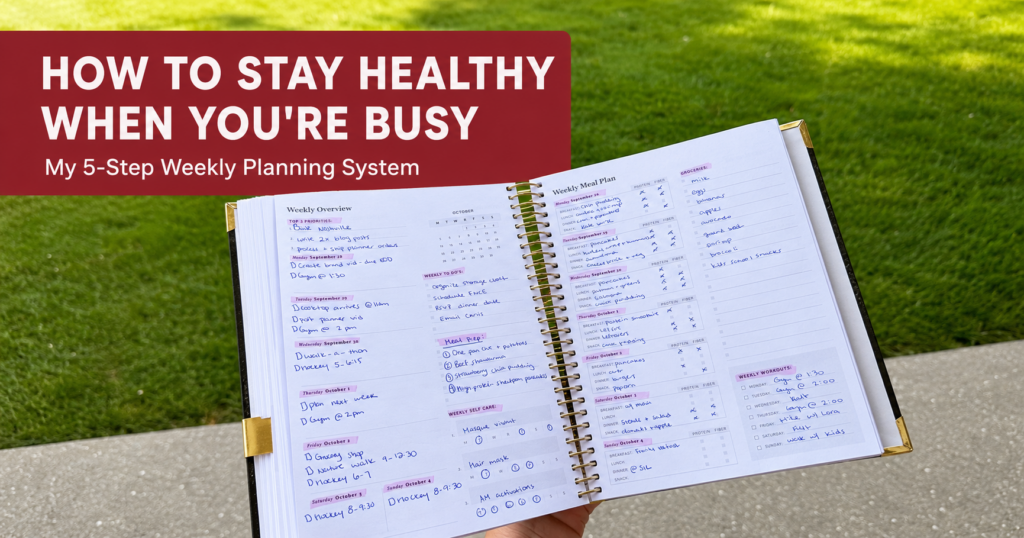
As a dietitian, mom, and business owner, I know how difficult it can be to figure out how to stay healthy when you’re busy.
Most of us do not need another list of things we “should” be doing.
We already know we should eat well, move our bodies, drink water, make time for ourselves, and work toward our goals.
Knowing is not usually the hard part.
The hard part is making those things happen during a real week filled with work, children, appointments, school activities, meals, laundry, household responsibilities, and everything else we are mentally carrying.
I am not motivated every single day. I get tired. My schedule changes. My children need me. Work gets busy. Sometimes the last thing I feel like doing is working out, cooking dinner, or completing the task I put on my calendar.
The biggest thing that helps me stay consistent is not motivation.
It is planning.
My healthiest weeks do not happen because I wake up every morning feeling motivated and make perfect choices all day. They happen because I make the most important decisions before the week gets busy.
That is the system I am sharing with you today.
- How Do You Stay Healthy When You’re Busy?
- 1. I Look at What the Week Actually Holds
- 2. I Decide What We Are Eating
- 3. I Always Plan an Emergency Dinner
- 4. I Put My Workouts and Self-Care on the Calendar
- 5. I Choose One Action That Moves a Personal Goal Forward
- Why Putting Pen to Paper Helps Me Follow Through
- What to Do When You Have No Motivation
- Why I Created My 2027 Planners Around This System
- The 2027 Planner Launch
- Frequently Asked Questions
- A Healthy Week Does Not Need to Be a Perfect Week
- You Might Also Like
How Do You Stay Healthy When You’re Busy?
If I wait until I am tired and hungry to decide what we are having for dinner, dinner becomes much harder.
If I tell myself I will work out “when I have time,” something else will almost always take that time.
If I keep a personal goal in my head without deciding what I need to do next, weeks or months can pass without me making any real progress.
This is why I believe a healthy week starts before Monday.
I often do my weekly reset on Thursday. That gives me time to look ahead, plan our meals, make my grocery list, and decide what needs to happen before the weekend begins. Then, if I want to prep food on Sunday, I already know exactly what I am making.
Planning does not mean controlling every minute or expecting the week to go perfectly.
My weeks change constantly. The purpose of my plan is not perfection. It is to create something I can return to when life inevitably changes.
Before a new week begins, these are the five things I plan.
1. I Look at What the Week Actually Holds
Before I plan meals, workouts, errands, or anything else, I look at our family calendar.
I start with the things that are already happening:
• School dates
• Kids’ activities
• Appointments
• Work commitments
• Travel
• Birthdays and events
• Deadlines
• Anything that requires preparation or driving time
I also do a quick brain dump of everything I have been mentally carrying. This includes phone calls I need to make, forms I need to complete, appointments I have been putting off, household tasks, emails, and anything else I keep telling myself I need to remember.
Then, I look at the week honestly.
Which nights are busy? When do the kids have activities? Which days require more driving? Am I traveling? When do I realistically have more time? What needs to be completed before a specific deadline?
A healthy plan that ignores your actual life is probably not a plan you will be able to follow.
I also leave some room for the unexpected. Filling every open space on the calendar may look productive, but it does not leave much room for real life.
The goal is to create a realistic plan I can follow, not an ideal schedule for a person who does not have my responsibilities.
2. I Decide What We Are Eating
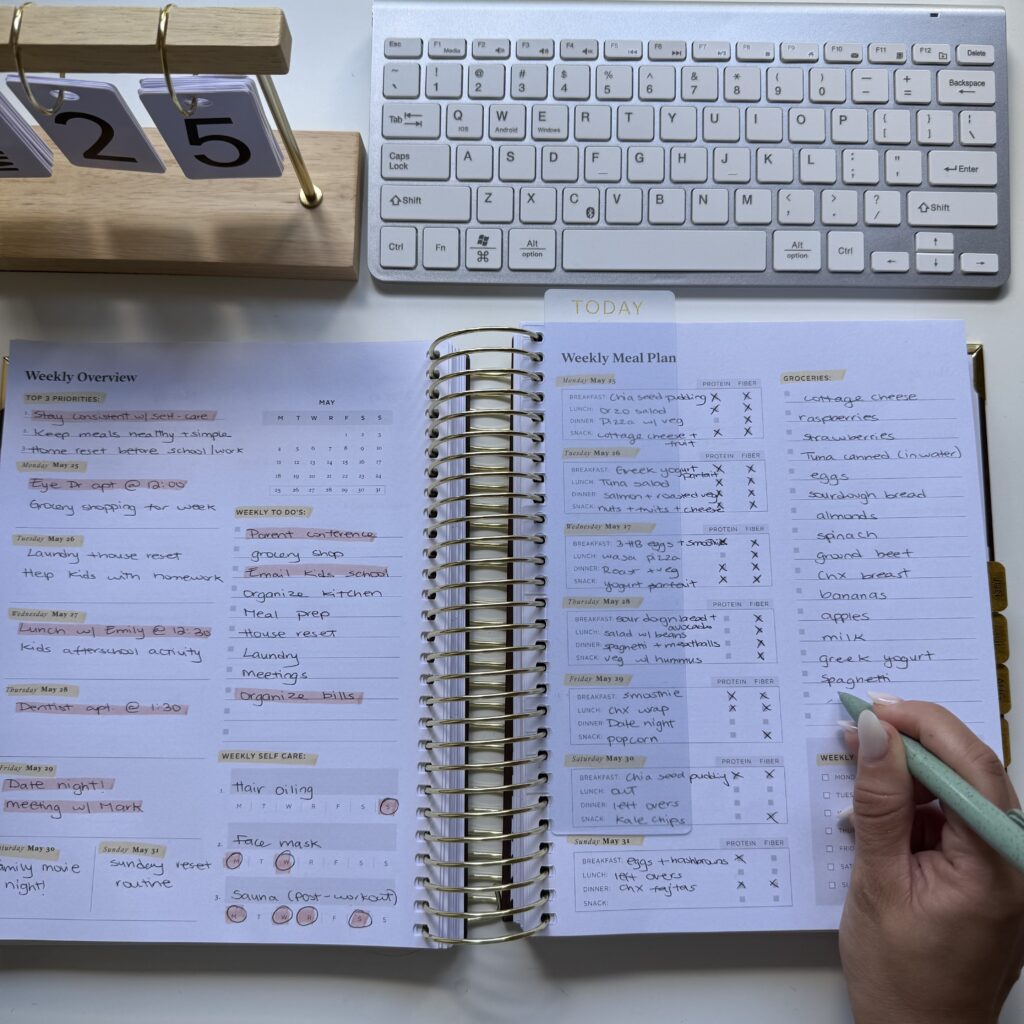
Once I know what our schedule looks like, I plan our meals around it.
I do not start by finding seven elaborate dinner recipes. I start by asking what will realistically work on each day.
A night filled with activities needs a different dinner than a night when we will all be home.
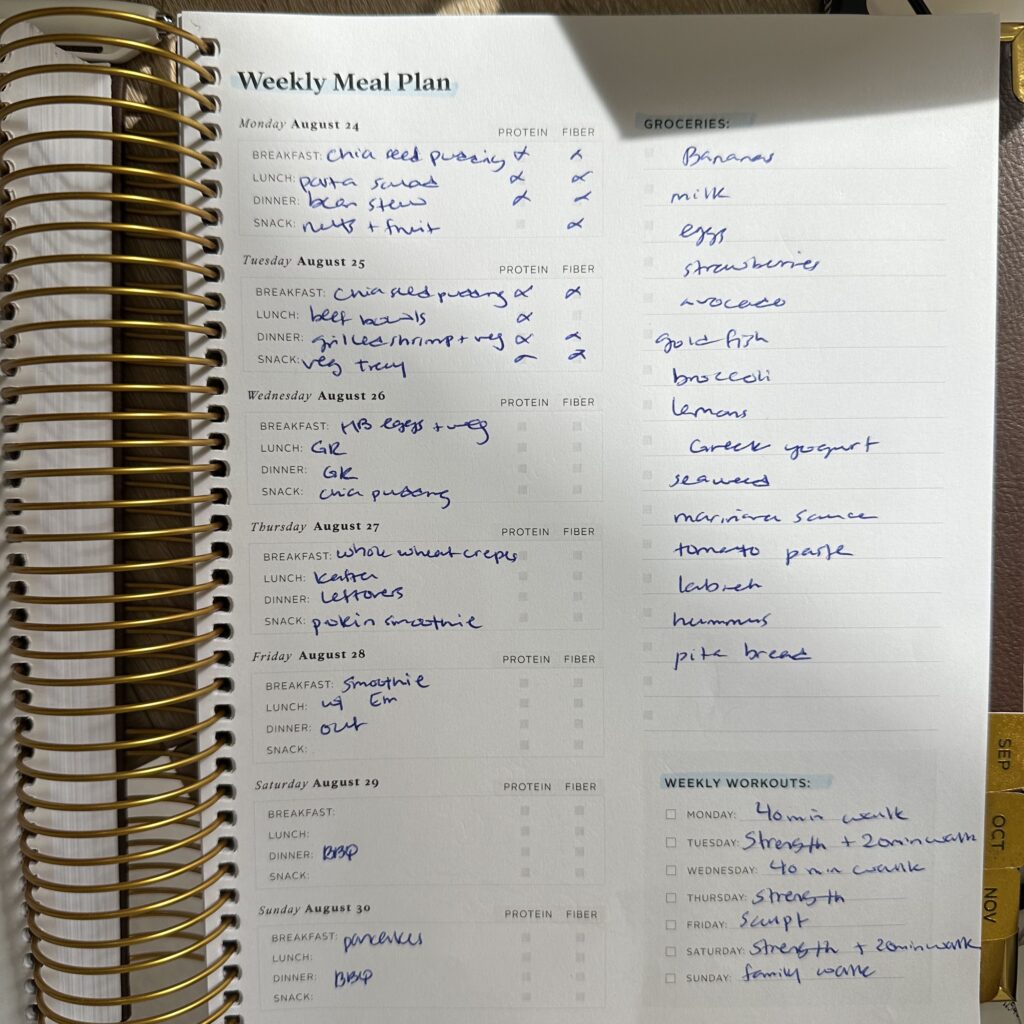
I usually choose a few realistic dinners for the week and leave some flexibility for leftovers, eating out, or plans changing. I also make sure we have easy breakfast and lunch options that include protein, fiber, and foods we genuinely enjoy.
As a dietitian, I care about the nutrition in our meals, but I also care about whether the plan is practical enough to follow.
A healthy meal does not need to be elaborate, and convenience foods can absolutely be part of a balanced week.
I might prep a few ingredients instead of preparing every meal completely. I may wash and cut produce, prepare a protein, make chia pudding, cook a grain, or make one lunch that can be portioned for several days.
The most helpful part is that the decisions are already made.
I do not have to start from zero every time someone is hungry.
Once I choose our meals, I create the grocery list at the same time. Keeping the meal plan and grocery list together makes it much easier to see what I need and avoid forgetting an ingredient.
See all of my Sunday meal-prep ideas
3. I Always Plan an Emergency Dinner
Even the best-planned weeks do not always go according to plan.
A meeting runs late. An appointment takes longer than expected. Someone is not feeling well. I am tired and do not want to cook what I originally planned.
This is why I always like having at least one emergency dinner available.
An emergency dinner does not need to be a complete recipe. I use a very simple formula:
Protein + carbohydrate + produce + something that adds flavor
That might look like:
• Rotisserie chicken, microwave rice, vegetables, and a favorite sauce
• Frozen meatballs, pasta, frozen vegetables, and pesto
• Chicken nuggets, potatoes, fruit, and a dipping sauce
• A quick sandwich or wrap with fruit and vegetables on the side
• A freezer meal I can heat when the day gets away from me
Healthy eating does not require cooking everything from scratch.
Having a backup meal available makes it much easier to feed my family without feeling like my only option is ordering food whenever the plan changes.
It also removes the pressure to follow the original meal plan perfectly. I know I have another option, so one difficult evening does not make the entire week feel like a failure.
4. I Put My Workouts and Self-Care on the Calendar
Writing “work out more” on a list is not a plan.
I plan my workouts the same way I plan a doctor’s appointment. I choose the exact day and time and put it on my calendar.
I would not miss a doctor’s appointment simply because I got busy or did not feel like going, so I try to give my workouts that same level of commitment.
Once they are already on the calendar, I can see that I do have the time because I have intentionally made space for them.
This is especially important when I am not feeling motivated.
I do not ask myself every morning whether I feel like working out. The decision has already been made. I only need to follow the next step on my plan.
That does not mean I never adjust my workouts. If something unexpected happens, I can move a workout. The important part is that I reschedule it instead of letting it disappear completely.
I use the same approach for self-care and personal appointments.
If I need to schedule a physical, dental appointment, vision appointment, haircut, facial, or anything else I have been putting off, I give it an actual place on my calendar.
If I do not intentionally make room for the things that take care of me, they will keep getting pushed behind everything I do for everyone else.
Taking care of yourself cannot always be the thing you do only if there happens to be time left over.
5. I Choose One Action That Moves a Personal Goal Forward
Healthy living is not only about food and workouts.
It is also about building a life in which you are continuing to grow, accomplish meaningful things, and make space for the person you want to become.
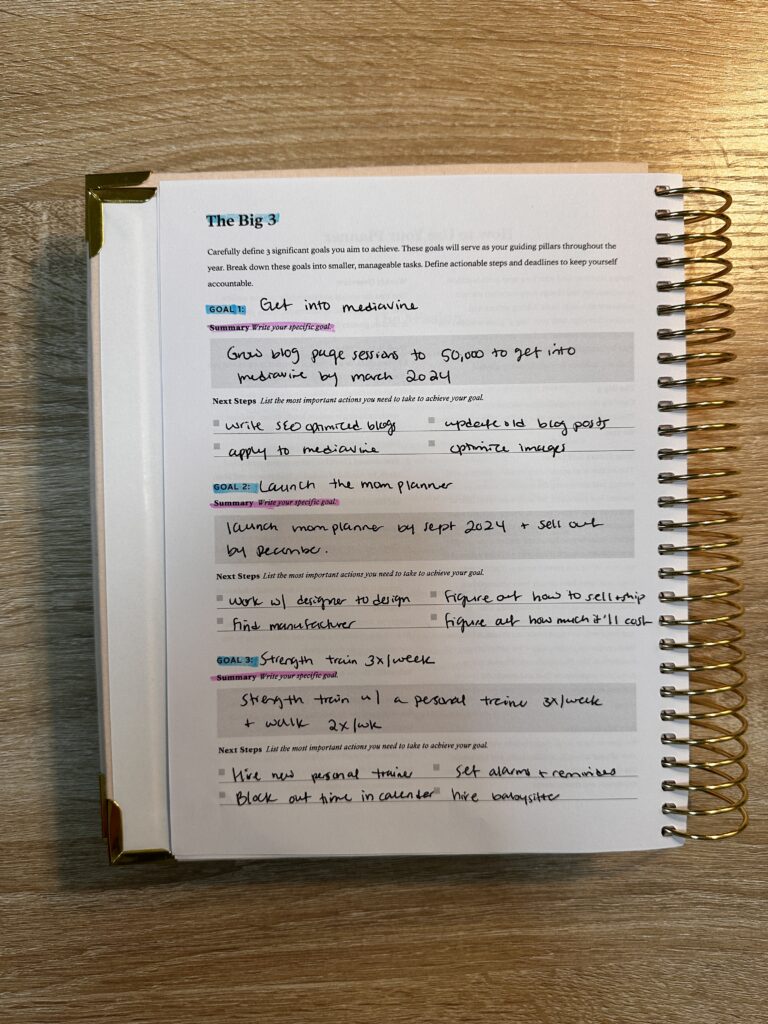
At the beginning of every year, I choose three big goals.
Only three.
These goals usually feel huge when I first write them down. Sometimes they feel so big that I wonder how I will possibly accomplish them within one year.
But I do not try to accomplish the entire goal at once.
I break it down.
I ask myself:
• What would completing this goal actually look like?
• What needs to happen during the next few months?
• What is the next specific step?
• What can I do this month?
• What can I do this week?
• When will I complete that step?
Then, I put that next action on my calendar.
A goal does not become real until it has a next step.
For example, creating and launching a physical planner did not happen because I continued thinking about how much I wanted to make one.
It happened through hundreds of smaller steps. Designing pages, reviewing proofs, making decisions about materials, approving samples, planning production, organizing inventory, taking product photos, building website pages, writing emails, and preparing for launch.
Looking at the finished goal all at once could have felt completely overwhelming.
Looking at the next step made it manageable.
This is how I approach my health goals, personal goals, family goals, and business goals. I stop staring at the finish line and focus on the next action I can actually complete.
Why Putting Pen to Paper Helps Me Follow Through
I have always been a pen-to-paper person.
Before creating my planners, I used different notebooks, sticky notes, calendars, and lists to organize everything I was trying to manage.
The problem was that my family schedule might be in one place, my meal plan somewhere else, and my business goals on a completely different page.
I needed to see everything together.
When I physically write down a goal, break it into steps, and place those steps on my calendar, it stays in front of me.
I am not relying on myself to remember it at the perfect time.
I genuinely believe that being organized and putting pen to paper is one of the biggest reasons I accomplish so many of the goals I set each year.
Writing things down helps me move from:
“I really want to do this someday.”
to:
“This is the specific step I am completing this week.”
That is a completely different way of approaching a goal.
My system moves from the year to the month, from the month to the week, and from the week to the day.
The big goal stays connected to the small action.
That is what keeps it from getting lost when life gets busy.
What to Do When You Have No Motivation
You will not feel motivated every day.
I do not feel motivated every day either.
Instead of expecting motivation to appear, I try to make the next action as clear and easy to begin as possible.
When I am struggling to follow through, I ask:
- What exactly did I plan to do?
- When did I plan to do it?
- What is the smallest version I can complete today?
- If today truly does not work, when am I rescheduling it?
“Work on my goals” is vague and overwhelming.
“Spend 30 minutes drafting the first page on Tuesday at 10 AM” is something I can actually complete.
“Get healthy” is vague.
“Plan three dinners, add two workouts to my calendar, and buy groceries on Friday” gives me a starting point.
Motivation is helpful when it shows up, but I do not want my health or my goals to depend on it.
The plan carries me on the days when the excitement is not there.
Why I Created My 2027 Planners Around This System
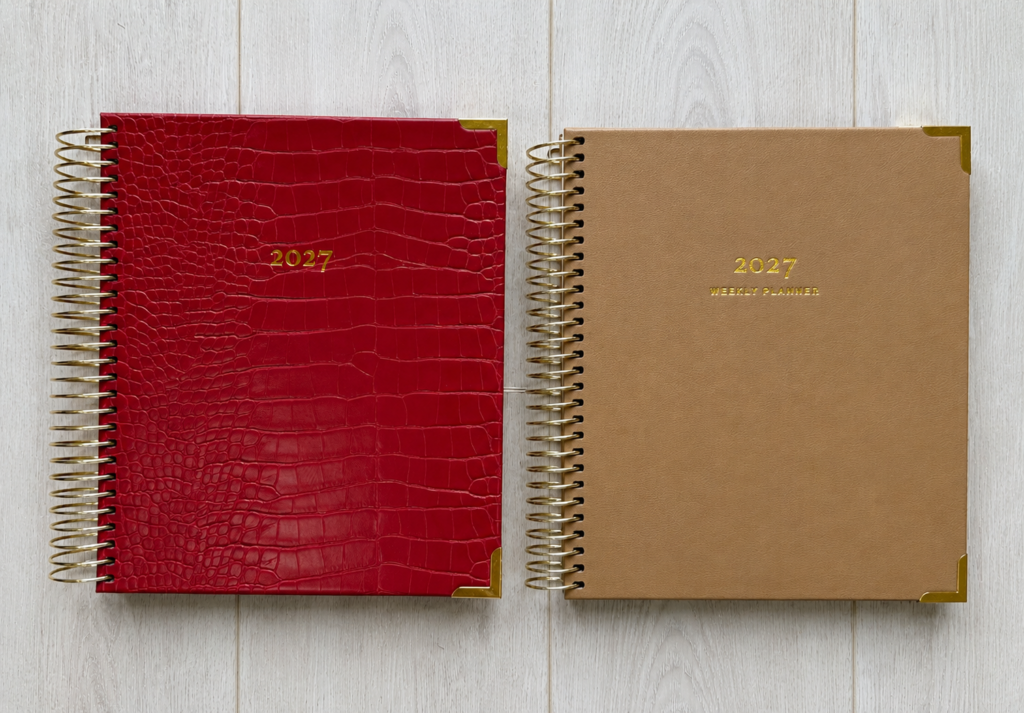
I needed more than a planner that only told me where I needed to be.
I needed one place where I could see my family’s schedule, plan meals and groceries, schedule workouts, make time for self-care, organize my priorities, and continue working toward my personal goals.
I did not want taking care of myself to happen only if there happened to be time left over. I also did not want my goals to be ideas I thought about once in a while.
I wanted them, along with the specific steps needed to reach them, front and center so I could actually follow through.
That is why I created my planners around the exact system I personally use.
Both the 2027 Daily Planner and 2027 Weekly Planner help you move from your bigger goals to your monthly priorities, weekly plan, and next actions.
They also bring your schedule, meals, grocery planning, workouts, self-care, and priorities into one organized system.
The Daily Planner provides more room to plan each individual day, including your top three priorities and an hourly schedule.
The Weekly Planner gives you a complete view of your week and includes a perforated grocery list that you can remove and take with you.
I will be sharing a complete Daily versus Weekly comparison in an upcoming post to help you decide which version fits your life best.
The 2027 Planner Launch
The 2027 Daily and Weekly Planners officially launch on Tuesday, September 15, 2026.
Everyone on the waitlist will receive early access at 9 AM ET, one full hour before the public launch at 10 AM ET.
This is the only inventory I produced for 2027. There will not be another production run or a restock once the planners are gone.
The planners sold out last year, and the waitlist for this year is already growing quickly.
Joining the waitlist does not guarantee that a planner will still be available, but it gives you the earliest opportunity to shop before the public launch.
Frequently Asked Questions
Make the most important decisions before the week begins. Review your schedule, plan a few realistic meals, choose an emergency dinner, schedule your workouts, and decide on one action that supports a personal goal. A simple plan reduces the number of decisions you need to make when you are already tired or busy.
Your weekly plan can include family commitments, work responsibilities, meals, groceries, workouts, appointments, self-care, household tasks, and your most important personal priorities. The plan should reflect your real schedule and leave some room for changes.
Do not rely on a vague intention. Choose a specific action, decide exactly when you will do it, and place it on your calendar. If the full version feels overwhelming, complete a smaller version or intentionally reschedule it.
Limiting myself to three big annual goals helps me stay focused. I would rather consistently work toward three meaningful goals than create an overwhelming list that I stop looking at after January. I break each goal into smaller steps and decide what I can do each month and week to keep moving forward.
Choose the Daily Planner if you want more space for detailed daily planning, top priorities, and an hourly schedule. Choose the Weekly Planner if you prefer seeing your entire week at once in a more streamlined format. I will be publishing a complete comparison before launch to help you choose.
A Healthy Week Does Not Need to Be a Perfect Week
You do not need a perfect meal plan, a rigid schedule, or endless motivation to take care of yourself.
You need a realistic plan that gives the things that matter a place in your life.
Look at the week in front of you.
Choose the meals that realistically fit.
Create a backup plan.
Put your workouts and self-care on the calendar.
Choose one action that moves a meaningful goal forward.
Then, focus on the next step.
Your healthiest life will not be built in one perfect week. It will be built through the small decisions and repeatable systems that help you keep showing up, even when life is busy.
You Might Also Like
If you found this helpful, here are a few more realistic ways to make your health, meals, and weekly routines feel more manageable:
• The September Reset: How to Get Back on Track This Fall
• Sunday Reset Routine for Moms